
This article first appeared on the Nottingham UNESCO City of Literature website. It was inspired by a book by Adrian Gray (see below) and BBC Radio Nottingham's highlighting of the Pilgrim Fathers' Nottinghamshire origins.
There was a time in
England, not so long ago, when it took courage to call for religious freedom. Even
the suggestion of such a thing was radical, dangerous and illegal. It was a
writer from Nottinghamshire that laid the foundation for religious tolerance.
His argument that followers of all faiths should be free to believe in the God -
or no God - of their choice, and practice any religion, had a global impact influencing
the American Constitution and the Universal Declaration of Human Rights.
The story begins with a book compiled by Nottinghamshire’s Thomas
Cranmer, the Book of Common Prayer, once
placed in every church in the land. Cranmer’s book is responsible for many
widely used phrases such as ‘ashes to ashes’ and ‘to love and to cherish’.

Cranmer was a clergyman, sought by Henry VIII had as an advocate
in his desire to divorce. In 1533 Cranmer was chosen as Henry’s first archbishop
of Canterbury. He duly declared the King’s marriage void. Two men from
Nottinghamshire who actively supported the Reformation were George Lassells, who
helped with the dissolution of the monasteries, and John Lassells, who was a
leading advocate of continued religious reform amongst staff and provided a
report that led to the execution of Catherine Howard.
After Henry VIII’s death, the House of Lords passed The Act
of Uniformity, abolishing the Latin mass in England and stating that all
services must be conducted in English and use the Book of Common Prayer. Loyal Catholics burned the book. In a
divided nation and time of mass killing, Cranmer produced a new and more
radical Protestant prayer book in 1552. With the premature death of the new
king, Edward VI, Cranmer’s plans were left in ruin. When Mary, a committed
Catholic, became Queen, Latin mass was back, and Cranmer was tried for treason,
and burned to his death in 1556.
After Mary died (in 1558), Elizabeth (a protestant) became
Queen. Elizabeth adopted the Act of Uniformity and stated that everybody had to
attend the Church of England and use the Book
of Common Prayer. Those not doing so were to be punished.
Up in north Nottinghamshire all was not well. Not satisfied
with the level of reform, a group of puritans wanted change. Among the reform
they craved was not to be told how to
prey, or be told which words to use. They wanted open prayer not a common
prayer book, but by 1583, the new Archbishop of Canterbury, supported by the
new Archdeacon of Nottingham, insisted that clergy agree to the full use of
Cranmer’s book.
By the century’s end the law had further tightened. Those
wanting to attend the church of their choice had little option but to conform
or leave. Many of the group bided their time, but the new king (King James,
1603) - turning out to be more conservative than they had hoped - refused
reform. In these times it was illegal to play games (or even run) on a Sunday;
it was illegal for a priest not to wear a surplice; and illegal not to have
your children christened. It was however, legal to abuse others for their
religious practices. After local clergy were removed from office, Askham-born Thomas
Helwys, who had now settled at Broxtowe Hall, had seen enough. The only layman
in a group of rebels he developed a Nottinghamshire network of some of the most
religious radicals in England and, facing further arrests, they prepared for
action.
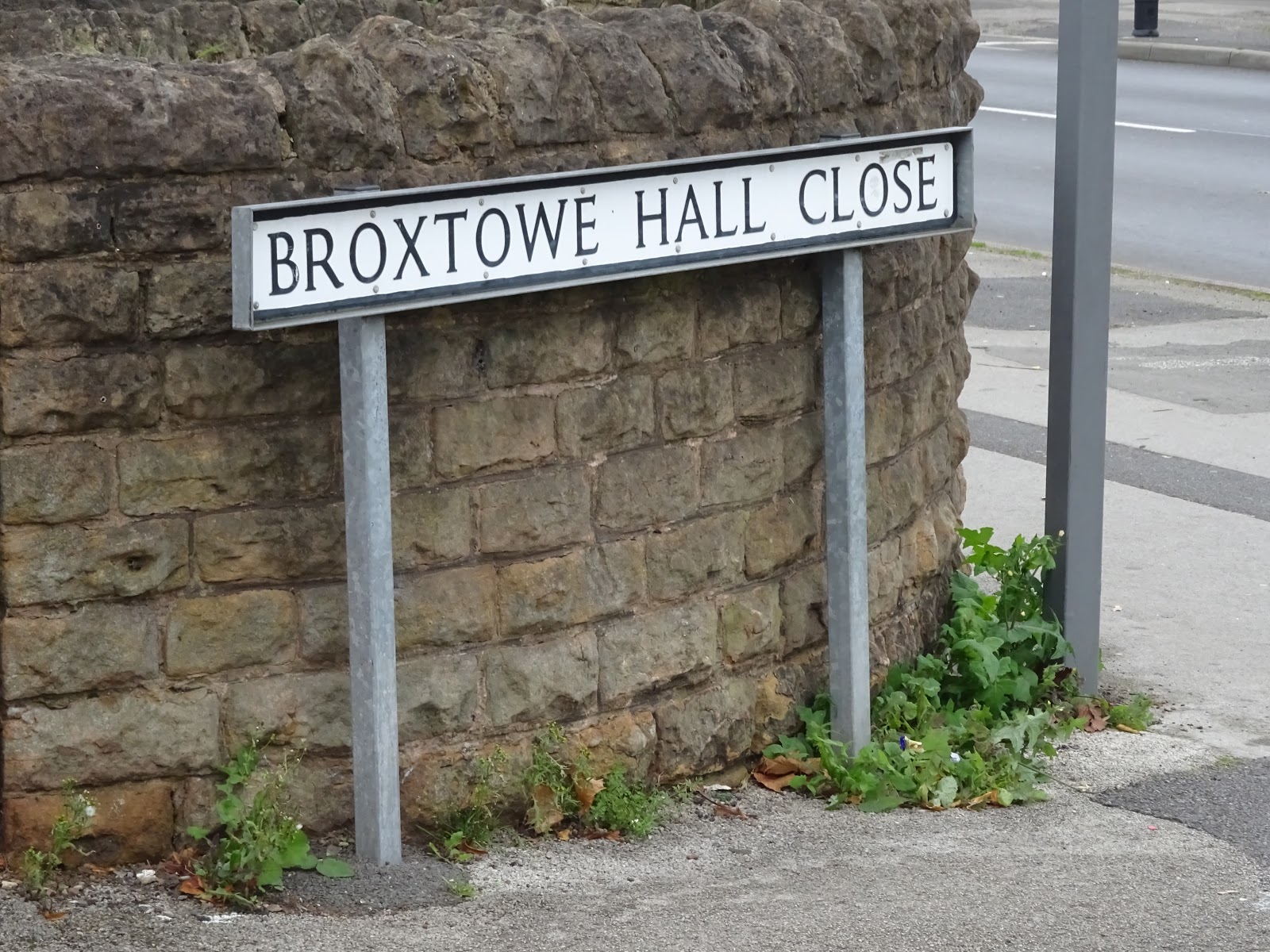 |
| Little remains of Broxtowe Hall. |
 |
| The tablet is the Helwys family memorial in Bilborough church. |

The idea that there should be a separation of state and the
church was not new but Helwys was the first to radically include any and all religions, and to write the argument in such terms, including
the point that anyone should be allowed to change religion. He may have died
but his argument lived on.
Helwys’ ideas of tolerance were further developed by his
friend John Murton and then by Roger Williams - the father of Providence, Rhode
Island - who married the daughter of another associate of Helwys, Richard
Bernard, former vicar of Worksop, himself an author of many books and a major influence
on Bunyan’s The Pilgrims Progress.
Aware of Helwys death, and in fear of persecution due to their
religion, the Pilgrims crossed the Atlantic on the Mayflower in 1620, starting
new colonies. The ideas of Smyth and Helwys were picked up through Murton’s
writing by Williams, who was banished from repressive Massachusetts and so set
up his own more tolerant state. These ideas are reflected in the first line of
the American Constitution’s First Amendment:
Congress shall make no
law respecting an establishment of religion, or prohibiting the free exercise
thereof…
And in Article 18 of the United Nations’ Universal
Declaration of Human Rights
1. Everyone shall have
the right to freedom of thought, conscience and religion. This right shall
include freedom to have or to adopt a religion or belief of his choice, and
freedom, either individually or in community with others and in public or
private, to manifest his religion or belief in worship, observance, practice
and teaching.
2. No one shall be
subject to coercion which would impair his freedom to have or to adopt a
religion or belief of his choice.
Over 400 years ago a
Notts writer argued for religious tolerance and for a tolerance of those
adopting no religion. Helwys’s influence was significant and many of his arguments,
whilst less radical in 2018, remain just as important.
For much more on this story, and the stories of other
important and influential rebels from these parts, I recommend the following
book:

Adrian Gray's From
Here We Changed the World: Amazing Stories of Pilgrims and Rebels from North Nottinghamshire
and West Lincolnshire tells the stories of local people, their struggles
and sacrifice, showing how those from our villages changed whole cultures. With
many images and fascinating biographies readers can discover how the origins of
most of the important English-speaking Protestant denominations can be traced
back to North Notts (and West Lincs). We have produced the first generation of Puritans,
the Separatists that followed, Congregationalists and the 'Mayflower' Pilgrims
and the first Baptists; then the Quakers, the Wesleys, Methodism and the
Salvation Army.
Adrian Gray’s fascinating book is available from the
Bookworm bookshop in Retford (email sales@bookwormretford.co.uk) and the
Nottingham Tourism Centre. It can also be ordered from most bookshops. 
Gray is a local historian and tour guide. With an MA in
history from Cambridge University, he is the author of more than twenty books
including several titles on Lincolnshire and Nottinghamshire. He is currently
finishing off a book to be called Land of
Prophets and Pilgrims and is part of the wider leadership team of Retford
Baptist Church. Visit http://pilgrimsandprophets.co.uk/


