Saturday

Two Books that Changed the World

This article first appeared on the Nottingham UNESCO City of Literature website. It was inspired by a book by Adrian Gray (see below) and BBC Radio Nottingham's highlighting of the Pilgrim Fathers' Nottinghamshire origins.
 
There was a time in England, not so long ago, when it took courage to call for religious freedom. Even the suggestion of such a thing was radical, dangerous and illegal. It was a writer from Nottinghamshire that laid the foundation for religious tolerance. His argument that followers of all faiths should be free to believe in the God - or no God - of their choice, and practice any religion, had a global impact influencing the American Constitution and the Universal Declaration of Human Rights.
The story begins with a book compiled by Nottinghamshire’s Thomas Cranmer, the Book of Common Prayer, once placed in every church in the land. Cranmer’s book is responsible for many widely used phrases such as ‘ashes to ashes’ and ‘to love and to cherish’.
 
Cranmer was a clergyman, sought by Henry VIII had as an advocate in his desire to divorce. In 1533 Cranmer was chosen as Henry’s first archbishop of Canterbury. He duly declared the King’s marriage void. Two men from Nottinghamshire who actively supported the Reformation were George Lassells, who helped with the dissolution of the monasteries, and John Lassells, who was a leading advocate of continued religious reform amongst staff and provided a report that led to the execution of Catherine Howard.
After Henry VIII’s death, the House of Lords passed The Act of Uniformity, abolishing the Latin mass in England and stating that all services must be conducted in English and use the Book of Common Prayer. Loyal Catholics burned the book. In a divided nation and time of mass killing, Cranmer produced a new and more radical Protestant prayer book in 1552. With the premature death of the new king, Edward VI, Cranmer’s plans were left in ruin. When Mary, a committed Catholic, became Queen, Latin mass was back, and Cranmer was tried for treason, and burned to his death in 1556.

After Mary died (in 1558), Elizabeth (a protestant) became Queen. Elizabeth adopted the Act of Uniformity and stated that everybody had to attend the Church of England and use the Book of Common Prayer. Those not doing so were to be punished.
Up in north Nottinghamshire all was not well. Not satisfied with the level of reform, a group of puritans wanted change. Among the reform they craved was not to be told how to prey, or be told which words to use. They wanted open prayer not a common prayer book, but by 1583, the new Archbishop of Canterbury, supported by the new Archdeacon of Nottingham, insisted that clergy agree to the full use of Cranmer’s book.
By the century’s end the law had further tightened. Those wanting to attend the church of their choice had little option but to conform or leave. Many of the group bided their time, but the new king (King James, 1603) - turning out to be more conservative than they had hoped - refused reform. In these times it was illegal to play games (or even run) on a Sunday; it was illegal for a priest not to wear a surplice; and illegal not to have your children christened. It was however, legal to abuse others for their religious practices. After local clergy were removed from office, Askham-born Thomas Helwys, who had now settled at Broxtowe Hall, had seen enough. The only layman in a group of rebels he developed a Nottinghamshire network of some of the most religious radicals in England and, facing further arrests, they prepared for action.
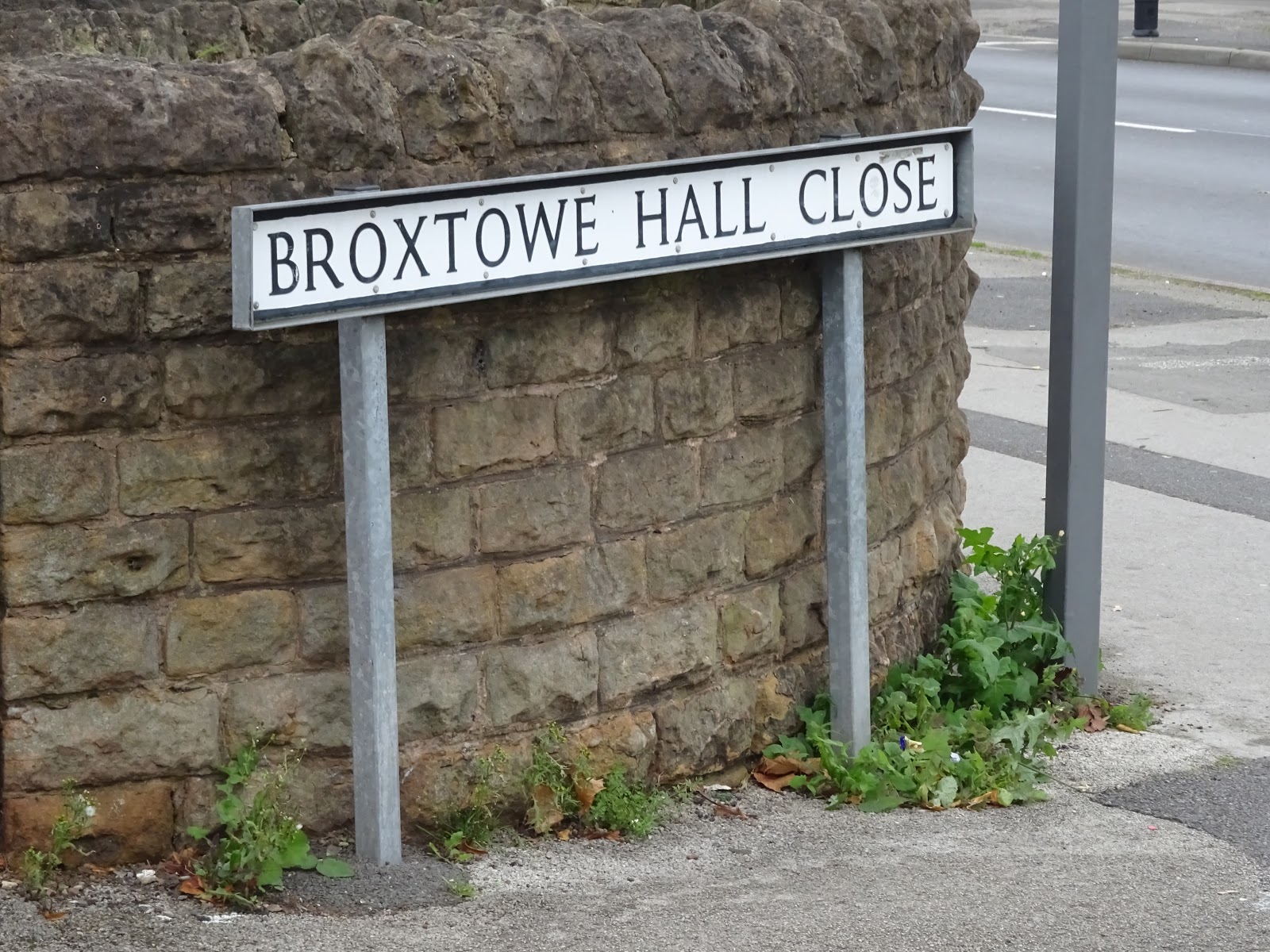
Little remains of Broxtowe Hall.
The tablet is the Helwys family memorial in Bilborough church.
In 1606 a conference was held at which some decided the best option was to move to the Netherlands. A year later, John Smyth, a leading separatist and radical theologian, was amongst those in Amsterdam. Helwys helped fund a move for others in 1608 before going himself. Smyth was the pastor that Helwys followed and they became the first two Baptists. A group from Scrooby settled in Leiden, many of whom would become the Mayflower Pilgrims and establish the American congregation.
After splitting from Smyth and others, Helwys wrote four or five books, returning to England in 1612 to start the English Baptist Church. That same year he wrote A Short Declaration of the Mystery of Iniquity, in which he argued that the State should have no control over religious faith, developing the view expressed by Smyth that magistrates should not be involved in matters of conscience. Helwys’s writing called for complete liberty of conscience in matters of religion for all people and argued for the same rights for all faiths.

The Mystery of Iniquity, split into four books, was one of the earliest English Baptist documents. For Helwys, any relationship with God should be both personal and voluntary. He identified two beasts, the Roman Catholic Church and the Church of England, and wrote of the cruel spiritual bondage of uniformity of interpretation, and stated that by forcing a single interpretation upon the people, the Church of England was guilty of spiritual tyranny. An autographed copy of his The Mystery of Iniquity was sent to King James. Helwys was subsequently arrested and sent to Newgate prison where he died.

The idea that there should be a separation of state and the church was not new but Helwys was the first to radically include any and all religions, and to write the argument in such terms, including the point that anyone should be allowed to change religion. He may have died but his argument lived on.
Helwys’ ideas of tolerance were further developed by his friend John Murton and then by Roger Williams - the father of Providence, Rhode Island - who married the daughter of another associate of Helwys, Richard Bernard, former vicar of Worksop, himself an author of many books and a major influence on Bunyan’s The Pilgrims Progress.

Aware of Helwys death, and in fear of persecution due to their religion, the Pilgrims crossed the Atlantic on the Mayflower in 1620, starting new colonies. The ideas of Smyth and Helwys were picked up through Murton’s writing by Williams, who was banished from repressive Massachusetts and so set up his own more tolerant state. These ideas are reflected in the first line of the American Constitution’s First Amendment:
Congress shall make no law respecting an establishment of religion, or prohibiting the free exercise thereof…

And in Article 18 of the United Nations’ Universal Declaration of Human Rights
1. Everyone shall have the right to freedom of thought, conscience and religion. This right shall include freedom to have or to adopt a religion or belief of his choice, and freedom, either individually or in community with others and in public or private, to manifest his religion or belief in worship, observance, practice and teaching.

2. No one shall be subject to coercion which would impair his freedom to have or to adopt a religion or belief of his choice.
Over 400 years ago a Notts writer argued for religious tolerance and for a tolerance of those adopting no religion. Helwys’s influence was significant and many of his arguments, whilst less radical in 2018, remain just as important.

For much more on this story, and the stories of other important and influential rebels from these parts, I recommend the following book:

Adrian Gray's From Here We Changed the World: Amazing Stories of Pilgrims and Rebels from North Nottinghamshire and West Lincolnshire tells the stories of local people, their struggles and sacrifice, showing how those from our villages changed whole cultures. With many images and fascinating biographies readers can discover how the origins of most of the important English-speaking Protestant denominations can be traced back to North Notts (and West Lincs). We have produced the first generation of Puritans, the Separatists that followed, Congregationalists and the 'Mayflower' Pilgrims and the first Baptists; then the Quakers, the Wesleys, Methodism and the Salvation Army. 
Adrian Gray’s fascinating book is available from the Bookworm bookshop in Retford (email sales@bookwormretford.co.uk) and the Nottingham Tourism Centre. It can also be ordered from most bookshops.

Gray is a local historian and tour guide. With an MA in history from Cambridge University, he is the author of more than twenty books including several titles on Lincolnshire and Nottinghamshire. He is currently finishing off a book to be called Land of Prophets and Pilgrims and is part of the wider leadership team of Retford Baptist Church. Visit http://pilgrimsandprophets.co.uk/


Thursday

Erasmus Darwin

Here is an article I wrote for the Nottingham UNESCO City of Literature website, on which it first appeared.

Erasmus Darwin, described as ‘The Da Vinci of the Midlands’, is a man whose philosophical poetry has been called dangerously radical. Without him ‘On the Origin of Species’ - perhaps even ‘Frankenstein’ - would not have been written. 

Son of a Nottingham lawyer, and the youngest of seven children, Erasmus Darwin was born at Elston Hall, near Newark, Nottinghamshire in 1731.


The Darwins’ long association with Elston in Notts began in 1680 and ended with the second world war.

In the mid-1750s Darwin qualified as a doctor and started a medical practice in Nottingham. With no patron to recommend him he only lasted a few months. After treating just one patient the physician moved to Lichfield. A few weeks later he successfully treated a young man for whom death had seemed inevitable. This feat, brought about through unconventional care, led to Darwin becoming famous. His unusual treatments included the advocating of exercise regimes and the use of herbal medicine. He was a strong believer in the benefits of good ventilation, putting holes into crowded rooms for the fresh air. He also held sympathetic views on mental illness, and was known to dish out the opiates and prescribe sex.

Unlike many of his generation Darwin had no sexual hang-ups. He had no issues with masturbation or homosexuality, and was known for having a large heterosexual appetite.

"Sexual reproduction is the chef d'oeuvre, the masterpiece of nature," he wrote. Darwin believed that reproduction allowed the imprinted patterns of experience to be passed on to each new generation, in a way that sits comfortably with the latest in epigenetics.

Word of Darwin’s reputation reached King George III who asked him to be his personal Royal Physician. Darwin declined. Business was booming, allowing the doctor the financial freedom to treat the poor free of charge.


Erasmus Darwin (1731 – 1802).

Darwin married twice and had at least fourteen children. Years after his first wife's death, he fell in love with a patient, the married Elizabeth Pole. He wooed her with a deluge of verse and, when the situation allowed, married her, moving his offspring in with hers.  

Through his poetry, Darwin wanted to achieve things and to change people’s attitudes, so he turned to ‘didactic poetry’ (poetry with a message/instruction). His purpose was "…to enlist imagination under the banner of science". It was an inventive mix; poetry that contained science and radical ideas including a new theory of biological evolution.  

Darwin translated the works of the Swedish botanist Carolus Linnaeus, producing volumes of work in which he coined many of the English plant names used today. One long poem ‘The Botanic Garden’ (1789), structured in rhyming couplets of four thousand lines, consisted of two parts, ‘The Economy of Vegetation’, and ‘The Loves of the Plants’.

‘The Economy of Vegetation’ attacked political tyranny and religious superstition. The poem includes a vision of the universe’s creation that’s much like the big bang theory; a pagan version that insists on a non-divine, self-regulating economy of the natural world.

It was ‘The Loves of the Plants’, a popular rendering of the Linnaeus' works, that contained Darwin’s first record of his theory of evolution. Produced by the radical publisher Joseph Johnson it was quickly followed by further editions. Johnson, later imprisoned for a ‘dangerous’ publication, paid Darwin a huge sum for the poem and went on to publish many of his future works. Darwin became a leading poet of his time and inspired many of the Romantic generation with his epic, erotic, evolutionary and philosophical images.

Mary Shelley’s idea for Frankenstein came as she overheard a conversation between her husband (Percy Shelley) and Lord Byron in which they referred to Erasmus Darwin. Byron would have been well aware of Darwin’s poetry and, tracing back to his time in Southwell, there is a loose but significant connection between a young Byron and Darwin through Elizabeth Pigot who encouraged Byron to publish his juvenile poems (1803/4). One final connection comes in 1824, as works by Darwin and Byron are published together: The Botanic Garden (Darwin’s poem in two parts) and Byron’s Poems (Don Juan) and his memoirs, were bound together in the one book. It made sense as by then both men had a reputation for being mad, bad and dangerous to know. A friend of Darwin’s, the chemist James Keir admitted that Darwin “paid little regard to authority.”

Darwin vigorously opposed slavery and included his views in his poetry and personal correspondence:

E'en now, e'en now, on yonder Western shores

Weeps pale Despair, and writhing Anguish roars:

Ee'n now in Afric's groves with hideous yell

Fierce SLAVERY stalks, and slips the dogs of hell.

Conscience must listen to the voice of Guilt:

Hear him, ye Senates! Hear this truth sublime,

"HE, WHO ALLOWS OPPRESSION, SHARES THE CRIME".

And in a letter he wrote to Wedgwood (the potter): "I have just heard that there are muzzles or gags made at Birmingham for the slaves in our islands. If this be true, and such an instrument could be exhibited by a speaker in the house of commons, it might have great effect."

Popular poetic taste began to turn away from Darwin after establishment-backed critics ridiculed his political ideas by attacking his heroic couplets. Samuel Coleridge, who thought of Darwin as "the first literary character of Europe, and the most original-minded Man" commented that "I absolutely nauseate Darwin's poem." His popular poetry was parodied, linking him with the French Revolution and the irreligious. In the early 1790s, Darwin nearly became Poet Laureate but the respected doctor was now seen as a crank and labelled an atheist. His next (and best) book ‘Zoonomia’ (or, ‘The Laws of Organic Life’) (1794–1796), wouldn’t help. Darwin’s nationwide approval turned to scorn. William Wordsworth used the book as the source for a poem he published in 1798 but popular opinion was disapproving. Darwin had expected his radical book to stir controversy, saying that he was "too old and hardened to fear a little abuse." However, his ideas caused great harm to his reputation.

In ‘Zoonomia’ he expanded upon the theory that life could develop without the guiding hand of a Creator. In this two-volume medical work Darwin incorporated pathology, anatomy, psychology and biology, and contained the ideas relating to the theory of evolution that were later developed by his grandson, Charles Darwin. The book had greatly influenced the doctor Robert Grant, who later mentored a young Charles.

Anticipating natural selection Erasmus Darwin wrote about "three great objects of desire" for every organism; those wants being "lust, hunger, and security." His idea that "the strongest and most active animal should propagate the species, which should thence become improved" predated the term ‘survival of the fittest’ by seventy years.
He wrote: “Would it be too bold to imagine, that in the great length of time, since the earth began to exist, perhaps millions of ages before the commencement of the history of mankind, would it be too bold to imagine, that all warm-blooded animals have arisen from one living filament, which THE GREAT FIRST CAUSE endued with animality, with the power of acquiring new parts, attended with new propensities, directed by irritations, sensations, volitions, and associations; and thus possessing the faculty of continuing to improve by its own inherent activity, and of delivering down those improvements by generation to its posterity, world without end!”

Undaunted in his commitment to progress Darwin offended political and religious conservatives equally. He was ridiculed for suggesting that electricity might one day have practical uses. He was criticised for his belief that women should have access to education, expressed in ‘A Plan for the Conduct of Female Education’ (1797). He was lambasted for his prodemocracy stance and argument that not just the owners of property should have the right to vote. And above all, he was hated for his views on creation, not helped when he added to the family's coat of arms the Latin phrase 'E conchis omnia' ('Everything from shells').

Together with contacts like Matthew Boulton, Josiah Wedgwood, and James Watt he set up the Lunar Society which became an intellectual powerhouse of the Industrial Revolution. Many ideas were shared, with Darwin displaying his incredibly creative and practical mind. He gave the first recognisable explanations of photosynthesis and the formation of clouds. He also invented many mechanical devices. His unpatented inventions include a flushing toilet, weather monitoring machines, a lift for barges, an artificial bird, a copying machine, a steering wheel for his carriage (a mechanism adopted by cars some 130 years later) and a speaking machine able to recite the Lord's Prayer and the Ten Commandments.

Darwin’s final long poem, ‘The Temple of Nature’, was published in 1803, a year after his death. The poem, originally titled ‘The Origin of Society’, is widely considered his best poetic work, tracing the progression of life from micro-organisms to civilized society and confirming his belief in shared ancestry. Like many of his works it owes much to Lucretius. 

A child of Nottinghamshire, Erasmus Darwin was a man who expressed his dangerous ideas and, looking back, was not only on the right side of history, he changed it. 

Charles Darwin wasn’t born until ten years after his grandfather’s death. He would have visited his ancestral home in Nottinghamshire and wrote a biography of Erasmus. He even named his first-born William Erasmus Darwin. Aware of the controversy his grandfather had aroused, Charles held off on publishing his own theory of evolution for many years.


With ‘On the Origin of Species’ (1859) and ‘The Descent of Man’ (1871) Charles was abused and satirised in much the same way Erasmus had been.

To many, the theory of evolution remains a dangerous and controversial.  

"All nature exists in a state of perpetual improvement." Erasmus Darwin.


Wednesday

Software for writers

Most authors persist with Microsoft Word, first released over thirty years ago, and ignore the plethora of new writers’ tools out there. There seems to be virtual assistance for every stage of the process, from developing ideas to generating sales, so let’s look at some.

First, let me say, writing is art, not science, there’s no shortcut key for the hours an author needs to invest in reading, writing and developing their craft. But technology, or the right technology, can certainly improve efficiency. Take the word count increasers: there’s a program that teaches ways of using a keyboard to increase writing speed (rapidtyping.com), one that allows writers to set word targets, with rewards and punishments if they’re met/missed (WriteorDie.com) and another that disables distractions such as Facebook and Twitter (anti-social.cc). They sound a bit gimmicky, I almost hear you say, and, productivity is one thing, what about quality?

Authors will tell you that first drafts are often rubbish, and that writing is rewriting. Software can help, allowing passages to be scanned and checked for the overuse of certain words or phrases, or the use of adverbs, even clichés (smart-edit.com). Or perhaps you are working on a story thread and want to call up all the chapters featuring a specific character, or all those with a certain setting. This can be done, easily, and you can view the chapters exclusively (Scrivner).

There is so much choice the difficulty comes in separating the useful programs from the pricy promises of success. The best way to do this is to ignore the imagination substitutes; the idea generators and formulaic structure templates that often produce uninspired results, recognised or standardised plots that fall flat. Creative writing software can sharpen your thoughts which in turn can help develop conflict, plot, characters and setting (yWriter) but often the best creative writing programs focus on recording your ideas through brainstorming tools (Freemind) or storyboarding applications (WriteItNow). Just remember, technology should support creativity, not supply it.

As far as research is concerned, search engines are the new libraries. Keeping this research accessible and organised is not so easy. Software can help the storing of files, images, notes and useful webpages; logging them in a virtual scrapbook that saves work to the cloud, making research and writing available in one place, and, if online, accessible through any computer or device you’re working on (Evernote.com). Not all research is electronic but it soon can be. Paper data, either a printout or handwritten, can be converted to information that you can edit at your leisure (SimpleOCR).

Backing up all this work, form a variety of sources, is important. Synchronising it all and automatically uploading everything to the internet can save time. Software that enables this, whilst also saving old versions, is crucial (Dropbox.com).

A final pointer on writing: there are many websites and groups where finished manuscripts can receive free critiques from communities of authors, editors, publishers and readers. This can provide vital feedback from peers, help grow an audience or even lead to a publishing contract (Authonomy.com).

Finding a publisher is often the next stage. Once a manuscript is ready, having been copy-edited and proofread properly (Preditors and Editors) more software becomes relevant.

Many of the well-known publishers’ commissioning editors accept new submissions via agents they trust. Authors must find the respectable genre specific agents and, if they’re accepting new work, follow their submission requirements exactly. One place to look is the Writers’ & Artists’ Yearbook and bear in mind that good agents don’t ask authors for reading fees or any money up-front.

Agents are now tougher to land than publishers but it’s a good time to be an author. Software has made self publishing affordable and potentially profitable. Ebooks are a great place to start as they can be produced, marketed and distributed so cheaply. They can be uploaded with software that allows for a table of contents, embed audio files or video, and makes books available on multiple platforms (Sigil). Big hitters like Smashwords and Kindle Direct Publishing offer free set up and take a percentage of royalties per sale. Others (BookBaby) can provide 100% royalties in exchange for an upfront fee.

Then there’s software to monitor sales across several stores (Trackerbox) and websites where agents sell a book’s foreign rights (pubmatch). You can even turn your book into an audiobook. Readers of Kindle books can now switch from reading to hearing a story, and this can be done mid-flow, flipping seamlessly between the two (Whispersync). The advancement of Apps has meant that many phones now play audiobooks. People are getting their content on the move and listening to stories is proving increasingly popular.

Print-on-demand is the most common method of publishing hard copies, and it avoids a garage full of unsold books. Amazon’s POD company (Createspace) has a wizard to guide authors through the process. There are other services that offer distribution to bookstores and libraries (Ingram). In addition to the manuscript assistance and editing help mentioned above, software can be used to create the covers. There are template-generated covers with the art and titling provided but it’s easy to create your own, technically speaking at least. If you can’t afford Photoshop then there are free alternatives (GIMP).

Having written and published a book, the other difficult part of an author’s triathlon is letting people know about it. One mistake many authors make is relying on others to do the marketing for them. Even if you have a publisher, or pay a marketing company, there’s no better person to sell your books than you. Another mistake is leaving the marketing until the book is available on Amazon. An online presence is important from the off and the right software can be effective in making sales.

Social media can help reach readers but it can also be time sapping. Thankfully there are useful tools for managing social media accounts. For example, you can schedule tweets to work for you while you’re offline (hootsuite.com) and link various social media networks together so that one message can be shared everywhere through a mobile App (Postcard).

Email marketing and list management is another key tactic and there’s free software that lets you compile email lists, track them and create professional looking emails that won’t appear as spam (AWeber).

Many writers now create and manage their own websites and have the advantage being able to update the content themselves (Wix.com). Communicating with readers is important and some authors are now producing Podcasts (Audacity) and YouTube videos (Pamela for Skype).

The more copies an author sells the more chance a new reader has of finding the book on the web. Racking up the 5 star reviews on amazon or Goodreads doesn’t affect their algorithms as much as sales. For reviews it’s better to focus on popular blogs and respected websites such as, for crime novels, crimefictionlover. Blog tours can also be of benefit and there are sites that manage these for you (Xpresso).

The software linked to above is a fraction of the help available. Some of it is free, some isn’t. It’s a case of finding what works for you. In my opinion the best of the programs for novelists is Scrivner. You can get a free trial here and learn the basics in the video above. For scriptwriters, try Final Draft where scripts can be translated into industry standard formats for film, TV or stage; scripts that can then be used to create multimedia productions (Celtx.com). While poets can access different structures and find rhymes at Poetreat.

It’s time to let technology work for you.

Saturday

Gedling Book Festival 2015

Gedling Book Festival 2015, supported by Gedling Borough Council, New Writers UK and Waterstones Nottingham.
June 12-14, Arnot Hill House, Arnot Hill Park, Arnold, Nottingham NG5 6LU
Free to attend. No booking required.
The line-up includes Stephen Booth, Alison Moore, Eve Makis and Vince Eager. From Dr Who to Tolkien there are over twenty talks and workshops to enjoy.
Friday 12th June
10am Mayor of Gedling Borough Council.
10.30am Historical novelist David Ebsworth talks about the women on the Napoleonic battlefields.
11.30am Alison Moore discusses the transition from her Booker nominated debut to her second novel He Wants.
12.30pm. From Authonomy to Scrivener, John Baird looks at some of the best websites and software for writers.
2.00pm Join the crime writer Stephen Booth for his talk entitled ‘Bring in the bodies!’
3.00pm Discover how Eve Makis has written history fiction through human stories.
Saturday 13th June
Children’s Day
10.10am, 10.30am and 3.00pm Storytelling for children with Julie Malone, Rob Hann and Steve Taylor.
Writing workshops with Steve Bowkett running at various times throughout the day
11.10am Tales from the TARDIS with David J Howe, contributor to over thirty titles about Dr Who.
12.20pm Best literary character, children’s costume award.
12.30pm Adventures of a visiting author, with children’s author Steve Bowkett.
1.30pm A spooky creative writing workshop for children with Sam Stone.
2.30pm Launch of the New Writers UK creative writing competition.
4.00pm Katy Perry tribute.
Sunday 14th June
Non-Fiction Day
10.30am The truth is out there somewhere, says Dr Nick Thom in his talk on writing about ancient history.
11.15am Ex-con Frankie Owens talks about life in prison and how he came to write a book about it.
12.15pm Frank Earp looks at the A to Z of Curious Nottinghamshire.
12.45pm Joe Earp examined Nottingham from old photographs.
2.00pm Rock ‘n’ roll star Vince Eager talks about his life, career and book.
3.00pm Professor Alison Milbank discusses J R R Tolkien.

Tuesday

Crime Day - Gedling Book Festival

CRIME DAY
 

Held in the lovely grounds of Arnot Hill Park

I opened the day with a talk on the ten most influential crime books

Nottingham Theatre Royal's over 55s writing group performed
'Rhymes and Misdemeanors'

Nicola Monaghan talked about her career and offered writing tips


David Bell focused on real-life crimes


Stephen Booth wowed his audience

Snooze you lose

All part of the Gedling Book Festival


Monday

The TEN Most Influential Crime Novels

The Ten Most Influential Crime Novels

As part of the Gedling Book Festival's Crime Day (and the CWA's National Crime Writing Month) I am giving a talk on the most important crime novels of all time, discussing the books that have had the biggest influence on crime writing, as well as those titles that have been so successful they've created new sub-genres, defining the crime books we read today.


Three classics that don't quite make the list
 

Nope, these didn't make the cut either.

It's all happening on Sunday July 14th at Arnot Hill Park in Arnold, Nottingham.
My talk is at 10.30am. Later in the day you can watch live performances and listen to the likes of Stephen Booth and David Bell. Should be fun.

More information on the Crime Day HERE

Wednesday

Crime Day - Gedling Book Festival


Killing A Mockingbird In Cold Blood


KILLING A MOCKINGBIRD IN COLD BLOOD

When naming a great American novel, you might choose To Kill A Mockingbird, or maybe In Cold Blood. But who wrote them?

In the 1930s, in Monroeville, Alabama, a young girl named Nelle, became best friends with the boy next door. She was mouthy, a non-conformist, a tomboy, a playground scrapper. He was small and, as a result, often grateful for his friend’s protection. They shared a love of reading and after being given an old typewriter they began writing stories together. They were to grow up to become two of the America’s finest authors: Harper Lee and Truman Capote.

Capote moved to New York City, joining his mother. In 1948 his first novel, Other Voices, Other Rooms, was published. Around that time, Lee headed to New York to pursue her writing career. After eight years of working menial jobs, she finally showed a manuscript to a publishing editor. Told that the novel was more like a string of short stories, Lee began rewriting and her frustration grew. Rumour has it that, one cold winter’s night in 1958, Lee chucked her entire manuscript out of her apartment window. That novel was To Kill A Mockingbird. Fortunately, she called the editor to inform him of her act and he insisted that she went straight outside to retrieve the work. She rescued the manuscript, literally, from the slush pile.

The story is told from the view of a six year old girl, Scout Finch, and clear similarities can be made with Lee’s own childhood in Alabama. In the book, a character called Dill spends his summers with Scout. He lives next door and brings with him a city boy’s perspective, whilst entertaining her with his tales. Dill is surely based on Capote, who, having left in the third grade, returned to Alabama every summer where he lived with his uncles and aunts. The hero of the novel is Scout’s father, Atticus Finch, who, like Harper Lee’s father, is a lawyer. The plot deals with class, morality and gender roles, but, most of all, it deals with race and prejudice. It is possible that a case involving Lee’s father directly shaped the story: In 1919 he had defended two black men (a father and son) who had been accused of murdering a white shopkeeper. Both clients were hanged. In the book, Atticus Finch defends a black man accused of raping a young white woman.

The plot certainly points to the pen of Lee but did Capote turn it into a masterpiece? It is on record that he read the manuscript and helped with the editing but how much of To Kill a Mocking Bird did he actually write?

In 1959, Capote is drawn to an article in the New York Times. It outlines the brutal shotgun killing of a farmer (Herb Clutter), his wife (Bonnie), and their two children (Nancy and Kenyon). The Clutters had been discovered bound and murdered at their home in Kansas, the mother and daughter found in their beds, the father and son slain in the basement. Capote decided to write about the murders and headed to Kansas, accompanied by his friend, Harper Lee.

Whilst they worked on a book about the murders, Lee’s To Kill A Mockingbird was published, with a quote from Capote on the jacket. The novel achieves rave reviews and becomes a bestseller. A year later, the novel lands the Pulitzer Prize. It has been said that Capote resented the book’s success – he was reluctant to quash suggestions that he was actually the author – but their friendship survived as the methodical, pragmatic Lee worked tirelessly on Capote’s 1966 novel, In Cold Blood. Was Lee in debt to Capote for his contribution to her success?

She spent the best part of six years researching the Clutter murders and interviewing the locals. Her findings provided the bedrock for the novel, and her interviews with the killers allowed the book to show their views from death row.

Capote thanked Lee in his dedication but did she get enough credit? 

Since In Cold Blood came out, it has never gone out of print. It’s spawned several movies and defined its own genre. When we begin the book, the reader knows that the Clutter family have been brutally murdered. This real family; hardworking, solid members of society, engage us and we soon become emotionally involved with their lives and the town folk, fearing their inevitable path.  

Both books have strong narratives; they raise questions about capital punishment and victimisation, and deal with uncovering the truth but, like Lee and Capote, they were quite different.

In Cold Blood was difficult to classify. It has been hailed as the first true crime book, and described as gothic fiction, but, I like Capote’s view that it’s a ‘non-fiction novel’. The idea of applying a strong story narrative to a non-fiction book was inventive. It reads like a stylish, haunting crime novel, but is also true account of the murders, the perpetrators’ arrest and their trail.

We will probably never know who had the most input into these seminal works of literature but it does seem that the authors conspired. Readers like the idea that a book has an author, singular, but that’s not always the case. With Lee and Capote, we have two great talents at work, neither of whom produced any work of note after the publication of In Cold Blood.

The fact that Capote failed to receive the Pulitzer Prize he was expecting did nothing for his relationship with Lee. His jealously and drinking may have led to problems in their friendship. What is known is that they never worked together again. Writing alone they were not the same force.

In the aftermath of To Kill A Mockingbird, Lee was uncomfortable with the public attention thrust upon her and went on to adopt a reclusive, private lifestyle. Capote, however, lived off the success of In Cold Blood, hobnobbing with the rich and famous whilst drug and alcohol abuse caused a slow public demise, resulting in his death in 1984.


Thursday

Strangers On A Movie


When the master of suspense hired the legendary hard-boiled detective writer

It is 1950 and Alfred Hitchcock is suffering a mid-career crisis. His latest films, Under Capricorn and Stage Fright have flopped. In need of a hit he comes across a thriller from first time novelist Patricia Highsmith entitled Strangers on a Train.

In the book, tennis player Guy Haines meets a stranger on train and, after sharing their problems, the two men agree to an exchange of murders. This way their crimes would appear motiveless. It seems a perfect plan as each will benefit from a murder for which they will have an alibi. Guy doesn't take the agreement seriously until his wife winds up dead. He is warned that he must fulfil his part of the deal or else…
Hitchcock secures the movie rights to the novel, paying $7,500. Highsmith would later be annoyed when she discovers that Hitchcock had bought the rights at a low price as a result of keeping his name out the negotiations.

Nervous of another failure, Hitchcock and Warne Bros. want an acclaimed writer to pen the screenplay. Eight big names are approached, including John Steinbeck, but they all reject the opportunity. Hitchcock turns to the great American crime writers and, after a deal with Dashiell Hammett falls through, he contacts Raymond Chandler. On reading the treatment, Chandler describes it is a “silly little story" and “implausible” but he takes the job anyway.  

It seems like a perfect collaboration; a script from the respected master of hardboiled crime fiction and a cinematic genius in the director’s chair.

Chandler is a no-nonsense writer. He wants to crack on with the script and works best alone. Hitchcock demands an input, making suggestions and putting forward his ideas for a scene. It is a recipe for disaster. In no time their relationship is in ruins. Chandler tells Hitchcock, “If you can go it alone, why the hell do you need me?” He describes their meetings as, "god-awful jabber sessions which seem to be an inevitable although painful part of the picture business.” His main gripe is the director’s willingness to forgo story and logic for dramatic effect.

On seeing Hitchcock arrive for a meeting, Chandler shouts, “Look at the fat bastard trying to get out of his car!"

Overhearing the remark, Hitchcock ceases talking to the writer. Chandler completes two drafts of the screenplay, without hearing a word from Hitchcock, before being dismissed.

Czenzi Ormonde is hired to write the screenplay. A fair-haired beauty with long shimmering hair, she resembles one of Hitchcock’s leading ladies and has no formal screenwriting credit to her name. Meeting her to discuss the script, Hitchcock makes a show of pinching his nose, then holding up Chandler's draft with his thumb and forefinger before dropping it into a wastebasket. Ormonde is informed that Chandler hasn't written a solitary line he intends to use. 

After reading the final script, Chandler writes the following letter to Hitchcock:

Dear Hitch,
In spite of your wide and generous disregard of my communications on the subject of the script of Strangers on a Train and your failure to make any comment on it, and in spite of not having heard a word from you since I began the writing of the actual screenplay—for all of which I might say I bear no malice, since this sort of procedure seems to be part of the standard Hollywood depravity—in spite of this and in spite of this extremely cumbersome sentence, I feel that I should, just for the record, pass you a few comments on what is termed the final script. I could understand your finding fault with my script in this or that way, thinking that such and such a scene was too long or such and such a mechanism was too awkward. I could understand you changing you mind about the things you specifically wanted, because some of such changes might have been imposed on you from without. What I cannot understand is your permitting a script which after all had some life and vitality to be reduced to such a flabby mass of clichés, a group of faceless characters, and the kind of dialogue every screen writer is taught not to write—the kind that says everything twice and leaves nothing to be implied by the actor or the camera. Of course you must have had your reasons but, to use a phrase once coined by Max Beerbohm, it would take a "far less brilliant mind than mine" to guess what they were.

Regardless of whether or not my name appears on the screen among the credits, I'm not afraid that anybody will think I wrote this stuff. They'll know damn well I didn't. I shouldn't have minded in the least if you had produced a better script—believe me. I shouldn't. But if you wanted something written in skim milk, why on earth did you bother to come to me in the first place? What a waste of money! What a waste of time! It's no answer to say that I was well paid. Nobody can be adequately paid for wasting his time.
(Signed, 'Raymond Chandler')


On the verge of releasing the film, Hitchcock and Chandler agree that the novelist should be removed from the credits. However, still wanting the prestige of the Chandler name, Warner Bros. list him as one of the film’s writers.

Strangers on a Train is a success and marks Hitchcock’s comeback. It endures as one of the director’s most popular movies.

Patricia Highsmith's career blossoms. She produces other psychological mystery novels that become adapted for the screen including The Talented Mr. Ripley, Ripley's Game and Edith's Diary.


The Reading Room

Nottinghamshire authors have recently been featured on Siren FM’s award winning The Reading Room.

Click to hear Podcast: ROOM 24 featuring a short story from thriller writer John Baird, whilst Nikki Valentine gives her nomination for their 101 Book To Read Before You Die.

Click to hear Podcast: ROOM 22 where Nikki Valentine provides the short story.

Click to hear Podcast: ROOM 21 where Booker prize nominated author Jon McGregor talks about his new collection of short stories This Isn’t the Sort of Thing That Happens to Someone Like You.

Siren FM’s The Reading Room recently took second place in an international award, seeing off Radio 4's The Today Programme, Melvyn Bragg's In Our Time and iTunes Live in the process.

The Reading Room broadcasts just once a month and features a mix of book reviews, interviews with authors, original short stories and poetry.

Paul Tyler has been hosting The Reading Room for almost two years with the aim of making literature more accessible and, after winning European Podcast Award's UK professional category, the show looks to go from strength to strength.

Friday

The Reading Room

Don’t Miss The Reading Room This Sunday and Tuesday!

'On this month’s programme, The Reading Room Book Group review the latest novel from Secret Diary of Adrian Mole author Sue Townsend, The Woman who Went to Bed for a Year .We also talk to crime author Elly Griffiths about her popular Ruth Galloway series, Georgia Twynham, author of The Thirteenth, will be live in the studio talking about the third book in her teen fantasy series, Nyteria Rising , and we have a short story from John Baird.

We also have poetry from Adrienne Silcock, Jamie McKay’s Musings of A Muddled Mind, more nominations for our 101 Books To Read Before You Dieand the usual eclectic mix of Sunday morning music.'

That’s Sunday the 1st, 10am-12noon, repeated Tuesday 7pm-9pm on Siren 107.3FM in Lincoln and around the world here at sirenonline.